
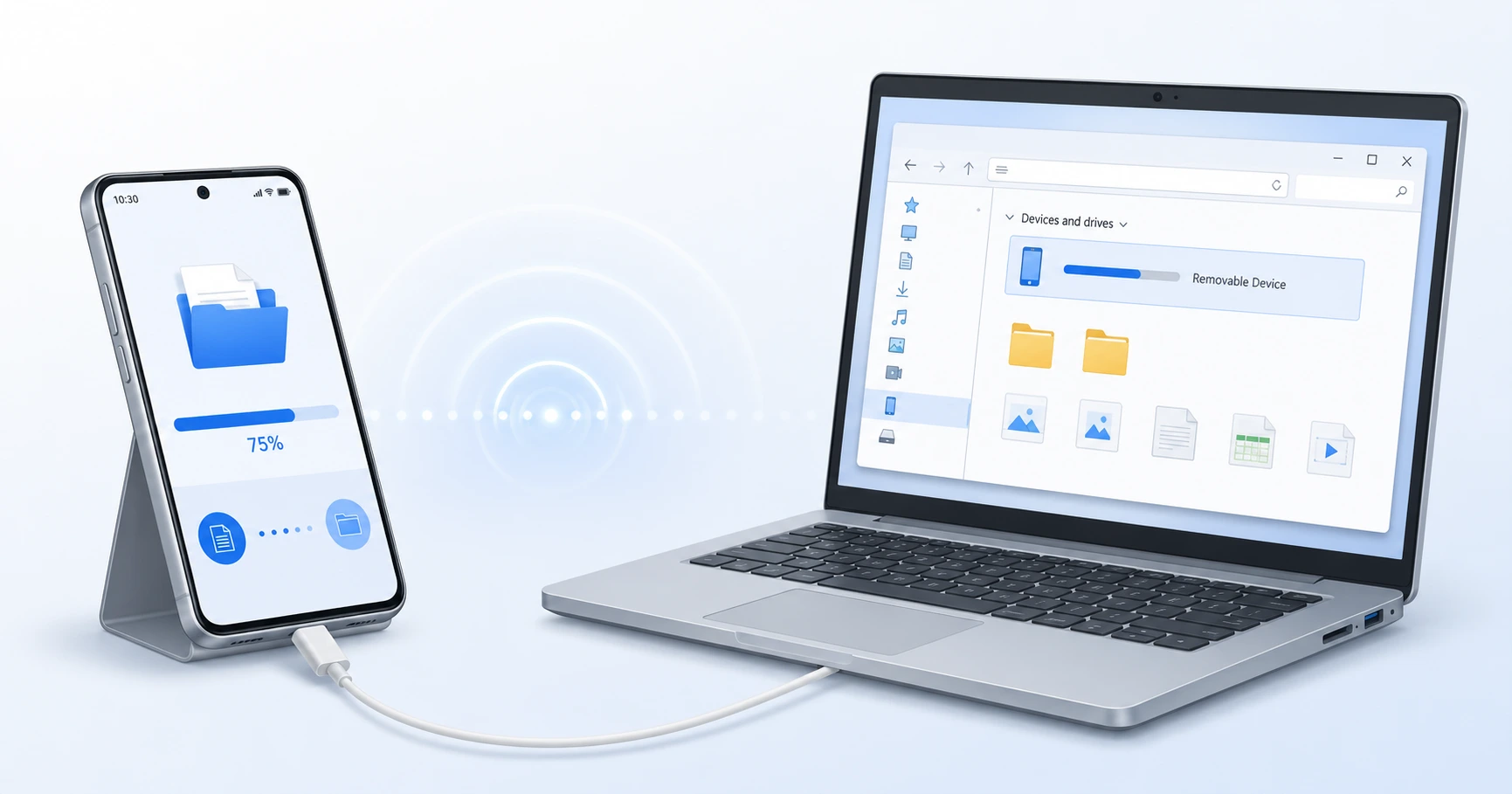
Which Phone to Laptop Connection Method Should You Use? (Quick Decision Guide)
Most people try the wrong method first. I see this constantly someone spends twenty minutes fighting with Bluetooth for a basic file transfer when a USB cable would have finished it in thirty seconds.
Every connection method has a specific job. USB handles large files fastest. Screen mirroring works for presentations. Mobile hotspots share your phone’s internet. Pick the wrong one and you’re just burning time.
Here’s what I recommend based on what you actually need:
For File Transfers Under 100MB: Bluetooth or AirDroid. No cables, quick setup, done.
For Large Files or Photos: USB cable, every time. Speed and reliability nothing else is close.
For Internet Sharing: Mobile hotspot. Your laptop joins your phone’s cellular connection like any WiFi network.
For Presentations or Gaming: Screen mirroring. Your phone screen appears live on your laptop display.
For Full Phone Control: Windows Phone Link. Mouse, keyboard, full app access — your phone runs in a window on your laptop.
Here’s what most people miss when they first research how to connect phone to laptop: you don’t need to buy or download anything. Every method covered here uses features already built into your phone and your Windows laptop. People install third-party apps they don’t need because they assume the built-in tools are limited. They’re not.
The terminology is what trips people up. Samsung brands their wireless mirroring as ‘Smart View.’ LG calls it ‘Screen Share.’ Other manufacturers say ‘Cast,’ ‘Mirror,’ or ‘Wireless Display.’ Same function every time, just different names on the button.
That’s exactly why I tell people to start with USB. Same process on every phone brand, every laptop. No branding confusion, no setup guesswork.
Which method makes sense for your situation comes down to three things: how big the files are, whether you have a cable within reach, and how often you’ll be doing this
How to Connect Phone to Laptop Using USB Cable (Most Reliable Method)
A USB cable works on the first try about ninety percent of the time. That’s why it’s always my starting point. Wireless methods fail for a dozen different reasons wrong network, wrong mode, driver issues, range. A cable eliminates most of that.
One thing worth doing before you plug anything in: check what name your phone actually broadcasts to other devices. Open Settings on your phone, go to About Phone, and look for Device Name or Bluetooth Name. Most people skip this and then stare at ‘Unknown Device’ in File Explorer wondering why Windows doesn’t recognize their Samsung Galaxy or Pixel.
When you plug the cable in, two things happen almost immediately. Your phone asks what you want to do with the connection. Your laptop may start installing a driver in the background. Both of those need to complete before you can actually move files.
Get the file transfer mode selection right and the whole process wraps up in under two minutes. Miss it — or dismiss that notification — and you’ll be troubleshooting a problem that doesn’t actually exist.
For Android Phones (Enable File Transfer Mode)
Android phones need MTP mode activated before Windows can read them as a file storage device. MTP — Media Transfer Protocol — is the communication layer Android uses to share files with a computer over USB. It’s not complicated once you’ve done it once, but the first time catches almost everyone.
Plug your phone in using whatever cable you normally charge it with. USB-C and micro-USB charging cables both handle data transfer without any issue. You don’t need a specialized cable.
The moment the cable connects, a notification drops into your phone’s notification panel. Pull it down and tap on it. You’ll get a list of options: ‘Charging only,’ ‘File transfer,’ sometimes ‘Photo transfer’ depending on which version of Android you’re running.
Tap ‘File transfer.’ On some older Android versions the option shows as ‘MTP mode’ instead same thing, different label. Windows will recognize your phone within about ten seconds and it’ll show up in File Explorer as a removable drive, usually listed by your phone’s actual model name.
If it’s the first time you’ve connected this phone to this laptop, Windows may spend a minute installing a driver automatically. Let that run. Once it finishes, your phone appears in File Explorer under This PC. Open it and you’ll see your phone’s internal storage and SD card if you have one.
If two minutes pass and nothing shows up, pull down your notification shade again. Android has a habit of quietly switching back to ‘Charging only’ mode without telling you. Change it back to File Transfer and your phone should appear immediately
For iPhone Users on Windows Laptops
Connecting an iPhone to a Windows laptop over USB requires either iTunes or the Apple Devices app — one of them needs to be installed before the connection will work properly. Android phones don’t have this requirement, which is why iPhone users often get caught off guard.
If you’re on Windows 10, download iTunes from Apple’s website directly (not the Microsoft Store version — it has compatibility issues). If you’re running Windows 11, the Apple Devices app from the Microsoft Store is the cleaner option. Either one handles the driver and sync functionality.
Plug in your iPhone using a Lightning to USB cable for iPhone 14 and older, or USB-C to USB for iPhone 15 and newer. Within a few seconds your iPhone will display a ‘Trust This Computer?’ prompt. This is the step that breaks the connection for most people when they miss it or dismiss it by accident.
Tap Trust. Enter your iPhone passcode when it asks. Without completing this, your laptop gets no access to the phone at all not even photos.
Once trust is confirmed, iTunes or Apple Devices picks up your iPhone automatically. In File Explorer, your iPhone shows up as a camera device, which gives you access to photos and videos. For everything else app data, backups, music you manage it through iTunes or the Apple Devices app directly.
If the Trust prompt never shows up, unplug the cable, wait ten seconds, and reconnect. If it still doesn’t appear, check that iTunes or Apple Devices is actually running in the background. The prompt sometimes won’t fire until Apple’s software is open and listening.
Use Your Phone as a Mobile Hotspot for Internet Sharing
Your phone turns into a WiFi router in about thirty seconds. The mobile hotspot feature converts your phone’s cellular data into a broadcast WiFi network — your laptop connects to it the same way it connects to any wireless network.
This is the fix I reach for whenever I’m somewhere with no reliable internet. Hotel WiFi tends to run slower than my phone’s LTE connection, so I just skip it entirely. Home internet down? Same thing. The hotspot has saved me more than a few remote work sessions.
The one thing that bites people is data usage. Running a hotspot burns through cellular data significantly faster than normal phone browsing, because your laptop is pulling background updates, syncing cloud services, and downloading files your phone never would. 500MB can disappear in ten minutes if you’re not watching. Most carriers throttle your speeds or charge overage fees once you hit your monthly cap, so keep an eye on it.
Also worth doing before you share: change the default password on your hotspot. Your phone broadcasts a visible network name that anyone nearby can see. The factory-set passwords aren’t always strong. Set something unique so you’re not paying for someone else’s browsing.
And when you’re done, turn the hotspot off. Leaving it running in your pocket drains your battery and keeps the network open.
Android Hotspot Setup (Step-by-Step)
Open Settings on your Android phone and look for either ‘Connections’ or ‘Network & Internet’ — the exact label depends on your phone manufacturer. Samsung uses ‘Connections.’ Stock Android uses ‘Network & Internet.’ Both lead to the same place.
Tap ‘Mobile Hotspot and Tethering,’ or on some phones just ‘Hotspot.’ Every Android phone has this option regardless of manufacturer, it’s just not always in the obvious spot.
Flip the Mobile Hotspot toggle on. Your phone immediately shows the network name and password. Take a screenshot of that screen or write it down — you’ll need that password on your laptop in the next step.
The default network name usually includes your phone model, something like ‘Samsung Galaxy A54’ or ‘Pixel 7.’ Worth changing that to something more generic if you’d rather not advertise your device model in public spaces.
If your phone gives you a band option — 2.4GHz or 5GHz — pick 5GHz for faster speeds when your laptop is close by. Stick with 2.4GHz if there’s some distance or walls between the two devices.
On your laptop, click the WiFi icon and look for your hotspot network name. Select it, type in the password, and your laptop connects within about ten seconds. From there it has full internet access through your phone’s cellular data.
iPhone Personal Hotspot for Windows Laptops
Apple calls it Personal Hotspot instead of Mobile Hotspot, but it does the same thing.
Go to Settings on your iPhone and tap ‘Personal Hotspot.’ If you don’t see it on the main Settings screen, tap ‘Cellular’ first and look for Personal Hotspot inside that menu — some carrier configurations bury it there.
Turn on ‘Allow Others to Join.’ Your iPhone displays the WiFi password right on that screen. The passwords Apple generates are random strings that look like keyboard mashing, so take a screenshot or you’ll definitely mistype it.
Your hotspot network shows up in your laptop’s WiFi list under your iPhone’s name. Mine appears as ‘John’s iPhone.’ Click your iPhone name in the list, enter the password when Windows asks, and that’s the connection made.
One thing worth knowing if you have both a Mac and an iPhone: Instant Hotspot lets your Mac connect automatically when both devices are signed into the same Apple ID. Windows doesn’t get that automatic feature, but the manual connection above takes under a minute
How to Mirror Your Phone Screen to Laptop (Free Built-in Method)
Most people have no idea Windows can display a phone screen wirelessly without any third-party software. I found this out while trying to help a friend navigate their phone with a cracked screen and it turned out to be the cleanest solution I’d found for a problem I’d been working around for months.
The way it works: your phone broadcasts its display over WiFi and your laptop receives it. Everything you tap or scroll on the phone shows up instantly on your laptop monitor. Presentations, photo slideshows, mobile games on a bigger screen it handles all of it.
The part that stops most people is that Windows doesn’t install the wireless display receiver automatically. It’s listed under Optional Features and has to be enabled manually. I’ve never seen a guide mention this step upfront, which is why so many people try it, get nothing, and assume their laptop doesn’t support it.
Also — and this one’s worth knowing before you start if the connection fails on the first attempt, don’t touch anything yet. Go back to your phone’s mirroring menu, tap your laptop’s name a second time, and it connects. I’ve watched this happen on at least a dozen different devices. The second attempt almost always works.
Setting Up Windows for Screen Mirroring (One-Time Setup)
Here’s the setup process. You only do this once.
Open Windows Settings and click ‘Apps’ in the left sidebar. Look for ‘Optional features’ and click into it. This section controls Windows components that ship disabled by default — Wireless Display is one of them.
At the top of the Optional features page, click ‘Add an optional feature.’ A search box appears. Type ‘Wireless Display’ and select it from the results. Click Install. The download takes two to three minutes.
On Windows 10 the path is slightly different: go to Settings, then Apps, then Apps & Features, then Optional Features. Same destination, different navigation.
Once installation completes, go back to Windows Settings and search ‘Projection settings’ in the search bar at the top. This opens the ‘Projecting to this PC’ configuration screen.
Change the first dropdown from ‘Always off’ to either ‘Available everywhere’ or ‘Available everywhere on secure networks.’ Set the second dropdown to ‘First time only’ — this way you only approve the connection once per device instead of every single session.
At the bottom of that page, click ‘Launch the Wireless Display app to project to this PC.’ A blue window opens on your desktop. When it’s active and visible, your laptop is broadcasting that it’s ready to receive. Keep this window open when you connect from your phone — the connection won’t work if it’s minimized.
Different Phone Brands Call It Different Names
The feature location varies by brand, so here’s where to find it on each one.
Samsung: Swipe down twice on the notification panel to open Quick Settings. Look for the Smart View icon — it looks like a small screen with a play symbol. Tap it and your phone scans for nearby wireless displays.
Google Pixel and stock Android: Pull down the notification shade and look for ‘Cast’ or ‘Screen Cast’ in the quick settings tiles. If you don’t see it, tap the pencil icon to edit tiles and add it.
OnePlus and Xiaomi: Both typically label this as ‘Wireless Display’ or ‘Cast.’ Find it in Settings under Connection or Display depending on the model.
Other Android brands: The icon almost always looks like a small rectangle with signal waves or an arrow pointing at a larger screen. If you can’t find it in Quick Settings, search ‘Cast’ or ‘Mirror’ inside the main Settings search bar.
iPhone: Open Control Center by swiping down from the top-right corner (iPhone X and newer) or swiping up from the bottom (older models). Tap ‘Screen Mirroring’ and your laptop should appear in the list if the Wireless Display app is running on your laptop.
Windows Phone Link: Control Your Phone Completely from Your Laptop
Phone Link does more than most people expect. It’s not just a screen mirror — it’s actual remote control of your Android phone from your Windows laptop. You can reply to WhatsApp messages, manage notifications, make phone calls, open and use any installed app, all using your laptop’s mouse and keyboard while your phone stays on your desk or in your pocket.
I spent months using third-party apps that made the same promise before I realized Phone Link was already installed on my laptop the whole time. The QR code pairing is the fastest setup I’ve found for any phone-laptop connection method.
Open your Windows Start menu and search ‘Phone Link.’ It comes pre-installed on Windows 10 and 11. On older Windows 10 installations it may appear as ‘Your Phone’ instead — same app, older name.
Open it and select Android when it asks for your device type. A QR code appears on your laptop screen immediately. On your Android phone, go to Settings and search ‘Link to Windows.’ If your phone has it built in, toggle it on. If not — which is common on phones not from Samsung or Microsoft Surface Duo — download the free ‘Link to Windows’ app from Google Play.
Tap ‘Link your phone and PC,’ choose ‘Scan QR code,’ and point your camera at the code on your laptop screen. The pairing completes in ten to fifteen seconds.
Your phone will request several permissions messages, photos, notifications, calls. Grant all of them. Phone Link doesn’t function properly if any of those are denied.
Once it’s connected, you get a live phone screen on your laptop. Click with your mouse, type with your keyboard. You can run up to three phone apps simultaneously in separate windows on your laptop desktop WhatsApp in one, Instagram in another, whatever you use most.
A few things worth knowing that Microsoft buries in the fine print: Phone Link requires your phone and laptop to be on the same WiFi network. It works best on Samsung Galaxy phones, where Microsoft has a deeper integration agreement features like running apps in Windows are Samsung-specific on many builds. iPhone support exists but is limited to notifications and photos because Apple’s system restrictions prevent the deeper access Android allows.
Phone Link does more than most people expect. It’s not just a screen mirror it’s actual remote control of your Android phone from your Windows laptop. You can reply to WhatsApp messages, manage notifications, make phone calls, open and use any installed app, all using your laptop’s mouse and keyboard while your phone stays on your desk or in your pocket. If you’re upgrading your entire workspace setup, our guide on how to connect two monitors to a laptop shows how to create a multi-screen productivity environment that complements phone control. I spent months using third-party apps that made the same promise before I realized Phone Link was already installed on my laptop the whole time.
How to Connect Phone to Laptop via Bluetooth for File Sharing
Bluetooth file sharing consistently catches people at the same point. The pairing part goes smoothly. Then they get stuck because the actual file transfer happens somewhere completely different from where they went looking for it and most guides don’t flag that gap upfront.
Here is the process from start to finish.
Pairing Your Phone with Your Laptop
Open Windows Settings and go to ‘Bluetooth & devices.’ Turn Bluetooth on if it isn’t already, then turn Bluetooth on your phone too. On your laptop, click ‘Add device’ and select Bluetooth from the options that appear.
Your laptop starts scanning. This is where the device name matters if your phone shows up as ‘Android’ or a random string of characters, you might not recognize it in the list. I always rename my phone to something obvious before pairing. Your actual name or something like ‘MyPhone’ works fine. It becomes a lot less confusing when there are multiple Bluetooth devices visible.
Make sure your phone’s Bluetooth is set to discoverable, not just on. Some phones default to non-discoverable mode, which means they won’t show up in the scan even though Bluetooth is running.
When your phone appears, tap it. Both screens display a PIN. Confirm they match, then accept the pairing on your phone. Pairing is done.
Transferring Files Over Bluetooth
Once paired, find the file you want to send on your phone. Tap Share and choose Bluetooth from the share options. Select your laptop from the device list that appears.
Your laptop shows a notification asking if you want to accept the file. Accept it. The file lands in your Documents folder inside a subfolder labeled Bluetooth easy to miss if you’re looking for it somewhere else.
Going the other direction from laptop to phone right-click the file in File Explorer, hover over ‘Send to,’ and select ‘Bluetooth device.’ Your paired phone shows up there. Select it and the transfer runs.
One Thing to Know About Speed
Bluetooth file sharing is slow. Not a little slow genuinely slow. A 50MB photo can take a few minutes. For a single document or one image, that’s manageable. For a video file or a large batch of photos, use USB or a hotspot instead. Bluetooth wasn’t built for that kind of workload.
Wireless File Transfer Apps and Cloud Services
Not every situation needs a cable or a pairing screen. Sometimes the right move is just uploading something and grabbing it on the other device. Wireless transfer apps and cloud services are built exactly for that.
AirDroid for Android
AirDroid wireless transfer works by putting your phone and laptop on the same WiFi network, then letting you manage files through a regular browser. Install the AirDroid app on your Android phone, open any browser on your laptop, and navigate to the web address the app gives you. Your phone appears in the browser and you drag files back and forth from there.
No cables. No pairing.
Speed depends on your WiFi connection, but on a standard home network it handles photos, documents, and moderate video files without much trouble. It’s not the fastest option on this list, but it’s the one I reach for when I need to grab a batch of screenshots off my phone and don’t want to dig out a cable.
One limit to be aware of: AirDroid’s free tier caps data transfer at 200MB per month. For occasional use that’s fine. If you’re moving files regularly, you’ll hit that ceiling faster than you expect and either need to upgrade or switch to a different method.
Cloud Services: Google Drive and OneDrive
Cloud file transfer is the laziest method and I mean that as a compliment. Upload on your phone, open your laptop, it’s already there. If you have Google Drive sync enabled, the file sometimes arrives on your laptop before you’ve even sat down.
OneDrive works the same way and has an advantage on Windows: Microsoft integrates it directly into File Explorer, so your synced phone files show up like a normal folder. No separate app to open, no login screen to get past.
The tradeoff is speed over slow internet large files take a while when your connection isn’t great. Also worth knowing: Google Drive’s free tier gives you 15GB of shared storage across Gmail and Drive. OneDrive’s free tier is 5GB. For documents and photos that’s rarely an issue, but if you’re syncing videos regularly you’ll hit those limits.
What to Do When Your Phone Won’t Connect to Your Laptop
Most connection problems trace back to one of four things: wrong USB mode, a missing or broken phone driver, a bad cable, or Bluetooth that got reset somewhere in your settings. The fix is usually fast once you know which of those four you’re actually dealing with and most people guess wrong and start with the most complicated one first.
Still nothing? Check Device Manager. Press Windows + X and click Device Manager from the menu. Look for any entry with a yellow warning triangle your phone may appear there under ‘Portable Devices’ or ‘Other Devices’ with an error flag. Right-click it and choose ‘Update driver.’ If Windows can’t find one automatically, search your phone manufacturer’s support page for the specific model driver. For detailed instructions on navigating Device Manager and resolving driver conflicts, Microsoft’s Device Manager troubleshooting guide walks you through each step. After updating the driver, unplug your phone, restart your laptop and reconnect the USB cable.
Common Connection Problems and Quick Fixes
Your laptop does not detect the phone at all over USB
Start with the cable, not the driver. Charging cables and data transfer cables look identical from the outside, but a significant number of charging-only cables physically can’t move data. Swap the cable before you do anything else — this alone solves it more often than people expect.
If a new cable doesn’t help, check your phone’s USB mode. When you plug in, your phone drops a notification asking what you want to do with the connection. If you dismissed that notification or missed it, your phone defaulted to ‘Charging only.’ Pull down your notification shade, tap the USB connection notice, and switch it to ‘File Transfer’ or ‘MTP.’ That change resolves the phone not being recognized by the laptop the vast majority of the time.
Also worth trying: plug into a different USB port on your laptop. Some ports have power or driver issues specific to that port.
Still nothing? Check Device Manager. Press Windows + X and click Device Manager from the menu. Look for any entry with a yellow warning triangle — your phone may appear there under ‘Portable Devices’ or ‘Other Devices’ with an error flag. Right-click it and choose ‘Update driver.’ If Windows can’t find one automatically, search your phone manufacturer’s support page for the specific model driver.
Bluetooth connection keeps failing or dropping
If the Bluetooth pairing works but the file transfer fails on the first attempt, go back to your phone’s Bluetooth menu, tap your laptop’s name, and try again. The first attempt drops more often than it should — sometimes because the connection handshake times out before either device finishes negotiating. The second attempt usually goes through without any changes.
If Bluetooth isn’t finding your phone at all, check that Bluetooth is enabled at the system level on both devices — not just toggled in Quick Settings. A system update on either device can silently reset Bluetooth to off, and Quick Settings sometimes shows the toggle as on even when the system-level setting is actually disabled.
Broken Screen Phone Solutions (Advanced)
A broken phone screen creates a specific problem: you can’t tap through the menus to authorize a USB connection or switch the file transfer mode. That blocks most recovery attempts before they start.
The most practical workaround uses a USB hub and an OTG adapter. Plug a USB mouse into the hub, connect the hub to your phone’s USB-C port using a USB-A to USB-C adapter, and you can navigate your phone’s interface with the mouse even with no working screen. It’s not elegant but it works consistently on Android phones. Use the mouse to open Settings, change the USB mode to File Transfer, and authorize the laptop connection from there.
If you’re comfortable with command line tools, Scrcpy is worth looking at. It’s a free open-source app that mirrors and controls an Android phone over USB from a laptop. The OTG flag in Scrcpy lets you take control of the phone before USB debugging has been enabled — which is precisely the obstacle broken-screen users run into. Download it from the official Scrcpy GitHub repository if you go this route.
For most people, the USB mouse method is faster and needs no software. But if your USB port is also damaged or neither option gets you in, a phone repair shop that specializes in data recovery is the realistic next step.
Quick Tips: Making Your Phone-Laptop Connection Work Better
The basic setup steps get you connected. These four things keep the connection from failing or running slower than it should
Same Network, Every Time
Every wireless method in this guide requires both devices to be on the same WiFi network not just the same router, the exact same network name. This is the most common reason wireless connections fail with no obvious error message.
The problem shows up most often on routers that broadcast separate 2.4GHz and 5GHz bands under different names. Your laptop ends up on one band, your phone on the other, and the connection attempt just times out. Check the network name on both devices before you start assuming something is broken with the method itself
Check both devices before you assume something is broken.
Data transfer between devices pulls more power from your phone than just sitting idle. If your phone drops to a low battery mid-transfer, the connection can cut out and leave files partially transferred or corrupted. Plug your phone in during any large transfer. Not after you start. Before.
For additional optimization strategies that can improve transfer performance, check our article on how to repair slow PC which covers system performance tuning applicable during file transfers. That last one I learned the hard way.
Use USB 3.0 Ports for Faster Data Transfer
The USB port you plug into matters. USB 3.0 ports usually identified by a blue plastic insert inside the port transfer data significantly faster than the older black USB 2.0 ports. For a handful of photos, the difference is barely noticeable. For a large video file or a full camera roll backup, it’s the difference between a few seconds and a few minutes.
Disconnect Screen Mirroring Properly
To stop a screen mirroring session without touching your phone, press Ctrl + S on your laptop keyboard. That disconnects the session cleanly in most Windows wireless display apps.
Most people just turn off their screen or close the laptop and leave the session open. When that happens, the phone and laptop sometimes stay in a partially connected state, which means the next time you try to mirror, the connection attempt either hangs or fails until you fully restart both the app and your phone’s mirroring feature.
Keep Your Phone Charged During Long Transfers
Data transfer between devices pulls more power from your phone than just sitting idle. If your phone drops to a low battery mid-transfer, the connection can cut out and leave files partially transferred or corrupted. Plug your phone in during any large transfer. Not after you start. Before.
That last one I learned the hard way.
Frequently Asked Questions
Why is my phone not showing up when I connect it to my laptop with USB?
Pull down your notification shade and switch the USB mode from charging to File Transfer or MTP. If that does not help, try a different cable, accept the “Trust This Computer” prompt on iPhone, or update the phone driver through Device Manager.
What is the difference between screen mirroring and Phone Link?
Screen mirroring only displays your phone screen on your laptop. Phone Link lets you fully control your Android phone from your laptop using your mouse and keyboard, including replying to messages and opening apps.
Can I use my phone’s internet on my laptop without WiFi?
Yes, through your phone’s mobile hotspot feature. Your laptop connects to the hotspot like a regular WiFi network, but the connection uses your phone’s mobile data, so watch your usage with heavy tasks.
Which connection method is fastest for large file transfers?
USB cable is fastest, especially through a USB 3.0 port. WiFi-based methods come second for moderate files. Bluetooth is the slowest and only practical for small documents or a few photos.
Do I need to install software to connect my phone to my laptop?
Not for basic USB or Bluetooth transfers since Windows handles both natively. Phone Link is pre-installed on Windows 10 and 11 but needs initial setup, and iPhone users may need iTunes for full file access.


2 comments